GST
GSTR-1 vs GSTR-3B: what each return does and why they must match
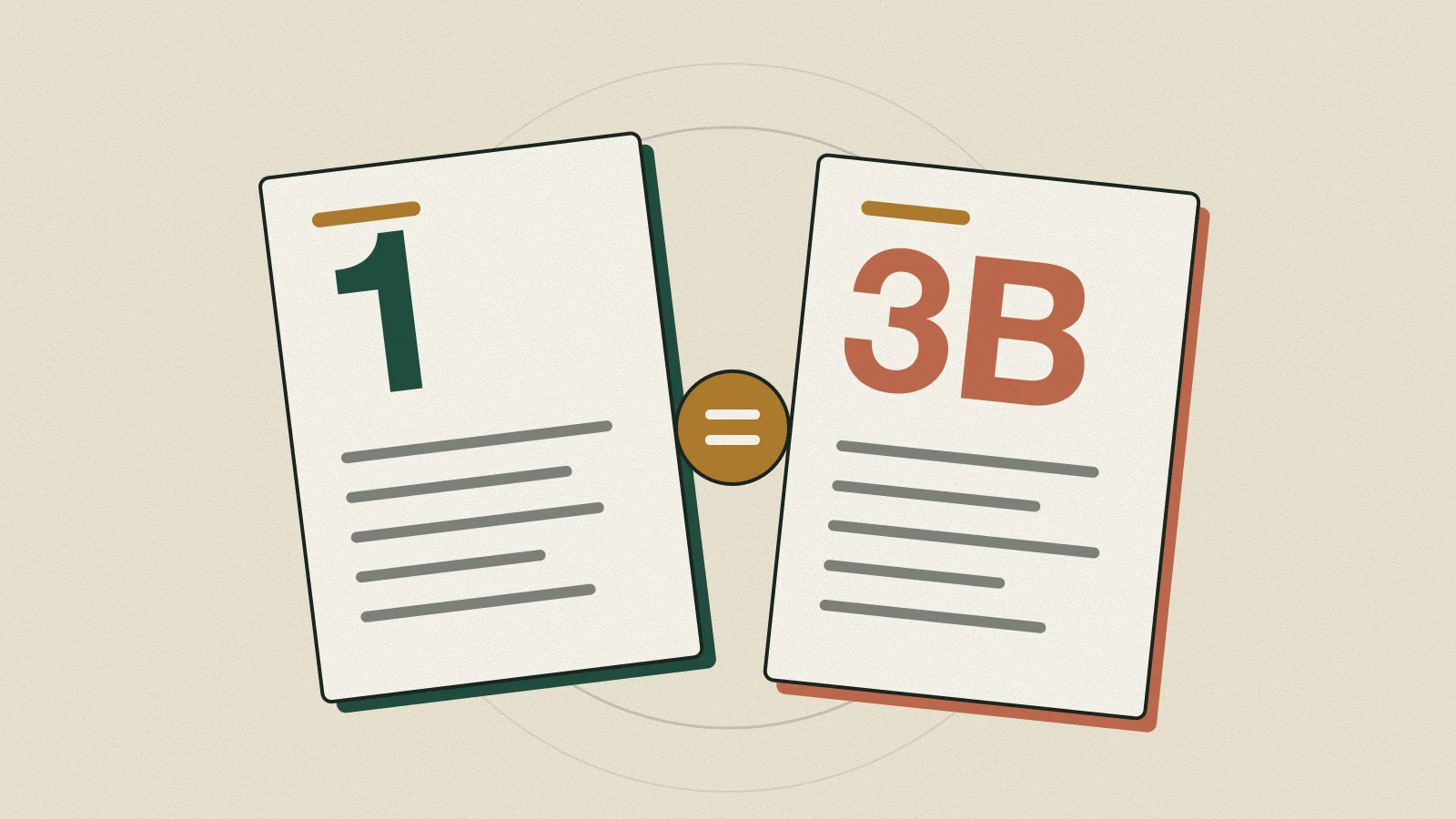
GSTR-1 reports what you sold, GSTR-3B pays the tax on it, and since 2025 the portal has made it much harder for the two to disagree.
A distributor of electrical goods in Indore gets an intimation on the GST portal in Form DRC-01B. It says the tax liability in his GSTR-1 for a month is higher than the liability he paid in GSTR-3B. His accountant traces it in an afternoon: a batch of invoices raised on the last day of the month went into GSTR-1, but the GSTR-3B had been prepared two days earlier from the billing software's summary and never updated. The tax was eventually paid the next month, with interest. The notice was still a nuisance, and his GSTR-1 for the following month was blocked until he replied.
Almost every small business has some version of this story. The two returns are filed by different people, sometimes on different days, from different reports. Since 2025 the GST portal has been closing the gap from its side, which helps, but it also means the old habit of fixing things in GSTR-3B no longer works.
What is the difference between GSTR-1 and GSTR-3B?
GSTR-1 is a detailed statement of your outward supplies: every B2B invoice, credit and debit note, and summaries of B2C sales, by tax rate and place of supply. GSTR-3B is a summary return in which you declare your total liability, claim input tax credit and pay the net tax. GSTR-1 tells the system what you sold; GSTR-3B settles the bill.
The two serve different people. Your buyers' input tax credit is built from your GSTR-1, because the invoices you upload flow into their GSTR-2B. Your own payment to the government is made through GSTR-3B. So a mistake in GSTR-1 hurts your customers, and a mistake in GSTR-3B hurts you.
A third form now sits between them. GSTR-1A lets you amend or add outward supplies for the same tax period after filing GSTR-1 and before filing GSTR-3B. It used to be a convenience. With liability locking, described below, it has become the main way to correct a GSTR-1 error in time.
When are GSTR-1 and GSTR-3B due?
For monthly filers, GSTR-1 is due by the 11th and GSTR-3B by the 20th of the following month. Businesses with aggregate turnover up to ₹5 crore can opt for the QRMP scheme, filing both returns quarterly while paying tax monthly, and optionally uploading B2B invoices through IFF in the first two months.
| Item | Monthly filer | QRMP filer |
|---|---|---|
| Outward supply details | GSTR-1 by the 11th of next month | IFF (optional) by the 13th for months 1 and 2; GSTR-1 by the 13th after the quarter |
| Tax payment | With GSTR-3B | PMT-06 challan by the 25th for months 1 and 2, by fixed sum (35%) or self-assessment |
| Summary return | GSTR-3B by the 20th of next month | GSTR-3B by the 22nd or 24th after the quarter, depending on the state |
| GSTR-2B available | 14th of next month | 14th of the month after the quarter (GSTR-2BQ) |
The 22nd or 24th split for quarterly GSTR-3B depends on which group your state or union territory falls in. Due dates are also extended by notification from time to time, so check the return calendar on gst.gov.in each month rather than relying on a printed chart.
The choice between monthly and QRMP is practical. QRMP means fewer filings, but if your B2B customers want their credit every month, you will end up filing IFF anyway. IFF has a value limit for the invoices you can upload in a month, so a business with large B2B sales may find monthly filing simpler.
How does GSTR-1 data flow into GSTR-3B now?
The portal pre-fills the liability tables of GSTR-3B from your GSTR-1, GSTR-1A and IFF. From the July 2025 tax period, that auto-populated liability can no longer be edited in GSTR-3B. If GSTR-1 is wrong, you correct it through GSTR-1A for the same period before filing GSTR-3B.
GSTN announced this in an advisory dated 7 June 2025, after earlier advisories in October 2024 and January 2025. A later advisory dated 5 December 2025 extended the same treatment to Table 3.2 (inter-state supplies to unregistered persons, composition taxpayers and UIN holders) from the November 2025 tax period. Values amended in GSTR-1A change the GSTR-3B figures immediately, and GSTR-1A can be filed any time until you file GSTR-3B.
Two more changes from early 2026 are worth knowing. From the January 2026 tax period, the portal computes interest on late GSTR-3B filing and fills it in; you can increase that figure but not reduce it. And from the February 2026 period, once IGST credit is fully used, the remaining IGST liability can be paid from CGST and SGST credit in any order.
The practical lesson is simple. Get GSTR-1 right, check the draft GSTR-3B against it before filing, and use GSTR-1A the moment you spot an error. The days of quietly adjusting a figure in GSTR-3B are over. Locking of the ITC side of GSTR-3B has been discussed separately, so check the current position on the GST portal's advisories page.
Where do GSTR-2B and the Invoice Management System fit in?
GSTR-2B is the monthly statement of input tax credit available to you, built from your suppliers' GSTR-1 and IFF. Through the Invoice Management System you accept, reject or keep pending each supplier invoice, and the resulting GSTR-2B feeds the ITC tables of your GSTR-3B. Invoices you take no action on are treated as accepted.
GSTR-2B is generated on the 14th of the following month. Before you file GSTR-3B, open IMS, reject invoices you did not receive or that carry wrong values, keep pending anything you are still checking, and recompute GSTR-2B if you changed anything. Rejected invoices do not flow into your ITC. Pending ones stay out of this month's GSTR-2B and can be acted on later.
The ITC you claim in GSTR-3B should, in normal months, be the GSTR-2B figure less any reversals you owe. Reversals include credit on goods written off, which for a pharmacy means expired medicines; our guide to pharmacy expiry management shows how that works.
Which mismatches lead to GST notices?
Two system checks catch most small businesses. Under Rule 88C, if the liability in GSTR-1 exceeds what you paid in GSTR-3B beyond a threshold, you get Form DRC-01B. Under Rule 88D, if ITC claimed in GSTR-3B exceeds what GSTR-2B shows beyond a threshold, you get DRC-01C. Both need a reply on the portal.
For each, you either pay the difference through DRC-03 with interest, or explain why the figures differ, for example invoices declared in GSTR-1 but whose tax was already paid in an earlier month. Ignoring the intimation is costly: the portal will not let you file GSTR-1 or IFF for the next period until you respond.
The common causes, in roughly the order a practising CA sees them:
- GSTR-3B prepared from a sales summary before the month's last invoices were entered.
- Credit notes uploaded in GSTR-1 but not reduced from liability, or the reverse.
- B2B invoices uploaded as B2C, or under the wrong GSTIN, so the buyer complains and you amend in a later month.
- ITC claimed on supplier invoices that the supplier uploaded late, so they fall into a different month's GSTR-2B.
- ITC claimed in full on invoices where part should have been reversed, such as blocked credits or goods written off.
- Advances, exports or reverse charge entries reported in one return and not the other.
Beyond these system intimations, a scrutiny notice in ASMT-10 or a show cause notice can follow larger or repeated differences, and those take far more time to close.
How much are the late fees and interest?
Late fee for GSTR-1 and GSTR-3B is ₹50 a day (₹25 CGST and ₹25 SGST), or ₹20 a day for nil returns, subject to caps. Interest under section 50 is 18% a year on tax paid late, calculated on the portion paid in cash, from the day after the due date.
The caps come from CBIC Notifications 19/2021 and 20/2021 (Central Tax), for tax periods from June 2021. Per return, they are:
- Nil return: ₹500 (₹250 CGST plus ₹250 SGST).
- Aggregate turnover up to ₹1.5 crore in the previous year: ₹2,000 (₹1,000 plus ₹1,000).
- Turnover above ₹1.5 crore and up to ₹5 crore: ₹5,000 (₹2,500 plus ₹2,500).
Larger businesses fall under the general cap in section 47, which is higher. Late fees and interest are amended by notification, so check the current position on the CBIC tax information portal.
A worked example
Suppose a trader with ₹3 crore turnover files his GSTR-3B for a month 15 days late. His total liability is ₹1,20,000, of which ₹40,000 is set off from ITC and ₹80,000 paid in cash. Late fee: 15 days at ₹50, which is ₹750, well under the ₹5,000 cap. Interest: ₹80,000 at 18% for 15 days is ₹80,000 x 0.18 x 15 / 365, about ₹592. Total cost of the delay: roughly ₹1,342, plus the risk that his customers' GSTR-2B and their goodwill suffered in the meantime.
Interest at 18% also applies to input tax credit wrongly availed and actually used, so a large excess ITC claim costs more the longer it stays uncorrected.
What is the three-year time limit on filing returns?
The Finance Act, 2023 bars filing GSTR-1, GSTR-3B, the annual return and several other returns more than three years after their due date. The legal change took effect from 1 October 2023, and the GST portal began enforcing it from the November 2025 tax period, so the oldest pending returns can no longer be filed.
The provisions sit in sections 37, 39, 44 and 52 of the CGST Act and cover GSTR-1, GSTR-1A, GSTR-3B, GSTR-4, GSTR-5, GSTR-5A, GSTR-6, GSTR-7, GSTR-8 and GSTR-9 or 9C. GSTN's advisory of 29 October 2025 gave an illustration: from 1 December 2025, returns barred included GSTR-1 and GSTR-3B for October 2022, quarterly returns for July to September 2022, and GSTR-9 or 9C for 2020-21. The window moves forward every month.
If you have old registrations or branches with gaps in filing, list them now. A return that cannot be filed does not make the tax go away; it only removes your chance to report it on your own terms.
A monthly GSTR-1 and GSTR-3B reconciliation routine
This is the routine most practitioners settle on for small clients. It takes an hour or two a month once the books are clean.
- Close the month's sales in the books, including credit notes, before preparing GSTR-1.
- Match the GSTR-1 totals by rate to the sales register and the GST output ledger.
- File GSTR-1 on time so your customers' GSTR-2B is complete.
- Review the draft GSTR-3B; if liability differs from your books, file GSTR-1A before GSTR-3B.
- After the 14th, work through IMS: accept, reject or keep pending, then recompute GSTR-2B if needed.
- Match GSTR-2B to your purchase register and list supplier invoices missing from it.
- Claim ITC as per GSTR-2B less reversals, and pay the balance before the due date.
- Reply to any DRC-01B or DRC-01C the same week it arrives.
- Once a quarter, list any return in any registration that is still pending and close it.
Most of this becomes routine when your billing and accounting software produces GSTR-1 directly from the invoices and reconciles GSTR-2B against purchases. Tatva ERP, made by Kentron Technologies, the publisher of this site, is one GST billing and accounting package that does this; our guide to choosing an ERP for a small business lists what to check in any of them.
Questions readers ask
Can I file GSTR-3B before GSTR-1?
You should not plan to, because GSTR-3B now takes its liability from GSTR-1, GSTR-1A and IFF and that figure cannot be edited. File GSTR-1 first, check the pre-filled GSTR-3B, correct anything through GSTR-1A, and then file GSTR-3B.
What happens if I made a mistake in GSTR-1 after filing GSTR-3B?
Once GSTR-3B is filed for the period, GSTR-1A for that period is no longer available. Correct the invoice through an amendment in the GSTR-1 or IFF of a later period, and pay any extra tax with interest in that period's GSTR-3B.
Is there a late fee for not filing IFF?
No. IFF is optional and cannot be filed after its due date, so no late fee applies. Invoices you missed can be reported in the quarterly GSTR-1 instead, though your buyers will then get the credit only after the quarter.
Why is my ITC in GSTR-3B different from GSTR-2B?
Usually because suppliers filed their GSTR-1 late, because you rejected or kept invoices pending in IMS, or because you reversed credit on blocked items or written-off goods. Keep a monthly reconciliation that explains every difference, since a large gap can trigger a DRC-01C intimation.
Can I opt for QRMP if my turnover is ₹6 crore?
No. QRMP is open only to taxpayers with aggregate turnover up to ₹5 crore in the current and preceding financial year. If turnover crosses ₹5 crore during a year, you move out of the scheme from the next quarter.
Sources
- 1.GSTN advisory, 7 June 2025: auto-populated liability in GSTR-3B to become non-editable (copy hosted by Maharashtra GST)
- 2.GSTN advisory, 29 October 2025: file pending returns before expiry of three years (copy hosted by Maharashtra GST)
- 3.GSTN advisory, 5 December 2025: reporting values in Table 3.2 of GSTR-3B (copy hosted by Maharashtra GST)
- 4.CBIC Notification No. 19/2021-Central Tax: GSTR-3B late fee caps
- 5.CBIC Notification No. 20/2021-Central Tax: GSTR-1 late fee caps
- 6.CGST Act, 2017, section 50 (interest on delayed payment) on the CBIC tax information portal
Sanjeevani Prime is published by Kentron Technologies, which also makes Healthixio and Tatva ERP. Where an article mentions those products, we say so. This article is general information, not medical, legal or tax advice; rules change, so check the sources above before acting. Read our editorial policy.
Keep reading
Inventory
Reorder levels, safety stock and min-max stock: a working method for Indian traders
How to decide, item by item, when to order and how much to hold, using numbers you already have in your sales and purchase registers.
22 November 2026 · 9 min read
Cash flow
Credit control for distributors: limits, ageing, collections and cheque bounces
A distributor's profit is made on the invoice and lost in the outstanding. Here is a routine to keep the money coming in, with the legal basics you should know.
22 November 2026 · 9 min read

Buying guide
How to choose billing and ERP software for a small Indian business
A vendor-neutral method for shop owners, distributors and pharmacies to compare billing and ERP software before signing anything.
22 November 2026 · 8 min read