Cash flow
Credit control for distributors: limits, ageing, collections and cheque bounces
A distributor's profit is made on the invoice and lost in the outstanding. Here is a routine to keep the money coming in, with the legal basics you should know.
Most distributors do not go short of cash because they sell at a loss. They go short because the money is sitting with retailers. A company stockist pays the principal in advance or within a week, gives 21 or 30 days to the market, and in practice waits 50. The gap is funded from the owner's cash credit limit at interest, and the interest is rarely charged on to anyone.
The fix is not a sharper salesman. It is a written credit policy, a report that shows who is late by how much, and a daily routine that somebody in the office owns. Below is how a well-run wholesale business does it, along with the legal basics on cheque bounces and the MSME payment rule that people often misunderstand.
How do you set a credit limit and credit days for each party?
Give every credit customer two numbers: a credit limit in rupees and credit days. A workable starting limit is the party's average monthly purchase × credit days ÷ 30, plus a cushion of about 20%. Credit days follow your own terms with the company. Review both every quarter against how the party actually pays.
Take a chemist who buys about ₹2,00,000 a month from you on 21 days. Twenty-one days of purchases is ₹1,40,000; add 20% and you get ₹1,68,000, rounded to ₹1,75,000. That is the most this party should owe you at any time. If he wants more, he must either pay faster or give a reason that the owner, not the salesman, accepts.
For new parties, start lower. Ask for two or three trade references, his GSTIN (and check on the GST portal that it is active), and the first few orders on advance or cash on delivery. Raise the limit after three months of clean payment. Keep the decision in writing, even a one-line note in the party master, so the limit does not depend on who is sitting at the billing counter.
The limit only works if billing respects it. Your software should warn the operator, and ideally stop the bill or ask for a supervisor, when a new invoice would take the party over the limit or when the party has a bill older than the agreed days.
What ageing buckets should a distributor track?
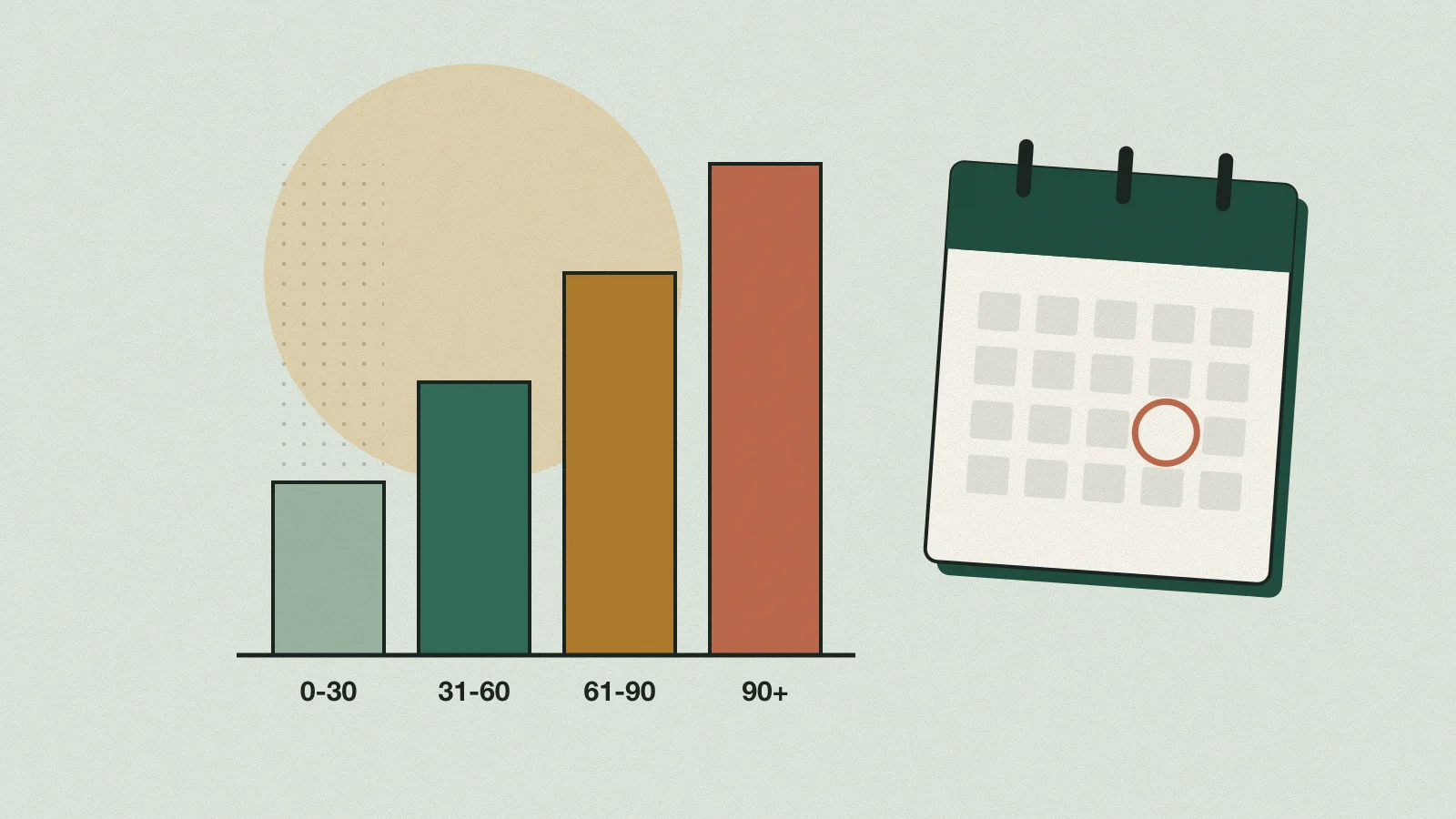
Track outstanding in four buckets by bill date: 0–30 days, 31–60 days, 61–90 days and over 90 days. The ageing must be bill-wise, so each receipt is adjusted against specific invoices, usually the oldest first. A party-wise total alone hides the old bills that matter most for collection.
Here is what an ageing report looks like for four parties (illustrative figures):
| Party | 0–30 days | 31–60 days | 61–90 days | Over 90 days | Total |
|---|---|---|---|---|---|
| Party A (chemist) | ₹1,10,000 | ₹0 | ₹0 | ₹0 | ₹1,10,000 |
| Party B (general store) | ₹65,000 | ₹48,000 | ₹0 | ₹0 | ₹1,13,000 |
| Party C (sub-wholesaler) | ₹30,000 | ₹22,000 | ₹41,000 | ₹0 | ₹93,000 |
| Party D (retailer) | ₹0 | ₹0 | ₹18,000 | ₹76,000 | ₹94,000 |
All four owe roughly the same total, but they are four different problems. Party A is fine. Party B is drifting and needs a reminder. Party C needs a visit and a hold on new billing until the 61–90 bill is cleared. Party D has stopped buying and stopped paying, which is the pattern that turns into a bad debt, and needs the owner's attention this week.
Insist on receipts being adjusted against bills at the time of entry. If the office posts a ₹50,000 cheque "on account", the ageing report becomes guesswork, and parties will happily argue that the old bill was already paid.
What does a good daily collection routine look like?
Every morning, one named person pulls the overdue list from the ageing report, sorts it by amount and age, and assigns calls, visits and reminders before the salesmen leave. Every evening, receipts are entered against bills, cheques are listed for deposit, and promises made during the day are noted with a date.
- By 9:30 am, print or view the overdue list: every bill past its credit days, largest and oldest first.
- Give each salesman his beat's overdue bills with amounts, so he collects on the same visit he takes orders.
- The office calls parties in the 31–60 bucket and sends a statement; the owner calls anything over 90 days himself.
- Note every promise: "₹40,000 by Saturday, cheque". Next morning, the list shows broken promises first.
- In the evening, enter every receipt against its bills, the same day. UPI and NEFT receipts get matched against the bank statement.
- Deposit cheques the next working morning, not at the end of the week.
- Once a week, the owner reviews the over-60 total and decides which parties go on hold.
Put the hold decision in the software, not in someone's head. A party on hold can still be billed against advance or cash, but not on credit. Salesmen dislike this at first; they tend to come round once they see that the first question at their counter becomes "how much is pending" rather than an argument.
How should you send payment reminders on WhatsApp?
Send reminders from the business's own WhatsApp number, not a salesman's personal phone, and attach a ledger statement or the list of pending bills. Keep the first message polite and factual, with bill numbers, dates and amounts. Escalate in steps: a reminder at due date, a firmer one at 15 days late, then a call from the owner.
A first reminder can be as plain as this: "Namaste, as per our records bills 2451 dated 3 October (₹18,400) and 2519 dated 9 October (₹22,750) are due today. Statement attached. Kindly arrange payment by UPI or cheque. Thank you." It gives the party nothing to argue about except the numbers, and if the numbers are wrong you want to know now, not at the year end.
A few practical rules. Send reminders on weekday mornings, when the shop owner is at the counter. Keep the UPI ID or bank details the same in every message so nobody is tempted by a fake "new account" message. Never threaten legal action casually on WhatsApp; if you mean it, it should come as a proper notice. And save the chat, because a party's reply confirming the balance is useful evidence later.
What should a distributor do when a party's cheque bounces?
Stop further credit to that party at once and get the bank's return memo. Under Section 138 of the Negotiable Instruments Act, 1881, you must send a written demand notice within 30 days of receiving the bank's information. The drawer then has 15 days from receiving the notice to pay; if he does not, a complaint can be filed in court.
The basics, from the text of the Act:
- The cheque must have been given for a debt or liability, and presented within its validity. The Act says six months or the validity period, whichever is earlier, and cheques today are valid for three months from their date.
- The demand notice must be in writing and go within 30 days of the bank telling you the cheque was returned unpaid, whether for insufficient funds or for exceeding the arrangement.
- The drawer gets 15 days from receipt of the notice to pay the cheque amount.
- If he does not pay, the complaint has to be filed within one month of that 15-day period ending, under Section 142.
- The offence is punishable with imprisonment up to two years, or a fine up to twice the cheque amount, or both.
The deadlines are strict and courts have thrown out complaints filed too early or too late, so hand the matter to a lawyer as soon as the memo arrives. You can read the section itself on Indian Kanoon. On the business side, reverse the receipt in your books the day the cheque comes back, so the ageing report shows the bill as unpaid again, and do not accept another cheque from the same party without clearing the first.
Does the MSME 45-day payment rule help a distributor collect from retailers?
Usually not. The rule protects micro and small enterprises that supply goods or services, and the Ministry of MSME has said that retail and wholesale traders on Udyam are covered for priority sector lending only, not for the delayed-payment provisions. A pure trading distributor generally cannot use it against retailers, but may have to follow it when paying its own MSE suppliers.
The rule has two parts. Section 15 of the MSMED Act, 2006 requires a buyer to pay a micro or small supplier by the agreed date, which cannot be more than 45 days from acceptance of the goods, or within 15 days if there is no written agreement. If the buyer pays late, Section 16 makes him liable for compound interest with monthly rests at three times the bank rate notified by the Reserve Bank. The income-tax side, introduced as section 43B(h) of the Income-tax Act, 1961, allows the buyer to deduct such a payment only in the year it is actually paid. In a July 2026 Rajya Sabha reply, the government confirmed that this now corresponds to section 37(2)(g) of the Income-tax Act, 2025, which came into force on 1 April 2026.
What it covers and what it does not:
- Covered: amounts owed to suppliers classified as micro or small enterprises, which in practice means manufacturers and service providers with Udyam registration.
- Not covered: medium enterprises, and retail and wholesale traders, even if they hold Udyam registration.
- Where it bites a distributor: if you buy from a small manufacturer, say a local packaging or snacks unit registered as micro or small, and pay after 45 days, the expense may not be allowed for tax until you pay, and the supplier can claim interest.
- Where to complain: the delayed-payment application now goes to the MSME ODR portal; the MSME Samadhaan site redirects new filings there.
Whether a particular supplier or customer is covered depends on its Udyam classification and its business, and the position has changed more than once. Confirm the current position with your chartered accountant before your tax audit, and on samadhaan.msme.gov.in before filing anything.
How do you calculate DSO, and what is a good number?
Days sales outstanding (DSO) tells you how many days of credit sales are sitting with customers. The formula is trade receivables ÷ credit sales for the period × days in the period. Compare it with your credit terms: if you give 21 days and your DSO is 30, customers are taking nine extra days on average.
A worked illustration. On 31 October, a distributor's debtors stand at ₹42,00,000. Credit sales for the last 90 days were ₹1,26,00,000.
- Daily credit sales = ₹1,26,00,000 ÷ 90 = ₹1,40,000.
- DSO = ₹42,00,000 ÷ ₹1,40,000 = 30 days.
- If the agreed terms are 21 days, the excess is 9 days × ₹1,40,000 = ₹12,60,000.
That ₹12.6 lakh is money you have effectively lent to the market for free. If it is funded from a cash credit limit at, say, 10% a year, the cost is roughly ₹1.26 lakh a year, which for many distributors is a large slice of net profit. Use credit sales only, not cash sales, and use a recent period such as the last quarter. Annual figures hide seasonal swings, so track DSO every month and watch the trend.
There is no universal good DSO. The useful comparison is with your own terms and your own last six months. A DSO that creeps up two days a month is an early warning, long before a party actually defaults.
All of this needs bill-wise outstanding, credit limits checked at billing time and an ageing report that is right every morning. Most accounting and billing software can do it; Tatva ERP (made by Kentron Technologies, the publisher of this site), for instance, warns before a bill takes a party over its credit limit and shows bill-wise ageing. If you are comparing systems, our guide to choosing ERP software covers what to test in a demo. Whichever you use, the routine above matters more than the tool.
Questions readers ask
Should I charge interest on overdue bills?
You can, if it is agreed in writing and printed on your invoices, but in practice most distributors use it as a bargaining point rather than collecting it. What works better is a clear hold on new credit once bills cross the agreed days. If you do charge interest, raise it as a separate debit note so the ledger stays clear.
What is the difference between a credit limit and credit days?
The credit limit caps how much a party can owe you in rupees at any time. Credit days cap how long any single bill can stay unpaid. A party can be within the limit and still be overdue on an old bill, so check both before billing.
Can I file a cheque bounce case if the party gave a post-dated cheque as security?
Courts have taken different views depending on whether a debt actually existed on the date the cheque was presented. Treat security cheques with care and take legal advice on the specific facts before sending a notice.
As a trader, can I file on the MSME ODR portal against a retailer who pays late?
Generally no. The Ministry of MSME's 2021 office memoranda allow retail and wholesale traders Udyam registration for priority sector lending only, not the delayed-payment benefits under the MSMED Act. Check the current position on samadhaan.msme.gov.in and with your CA.
How often should I review credit limits?
Quarterly is a sensible rhythm for most parties, with an immediate review whenever a cheque bounces, a bill crosses 60 days or a party's purchases change sharply. Reduce limits as readily as you raise them.
Sources
- 1.Negotiable Instruments Act, 1881, Section 138 (text via Indian Kanoon)
- 2.MSME Samadhaan, Ministry of MSME (delayed payment applications, now redirected to MSME ODR)
- 3.Rajya Sabha reply on section 43B(h) and section 37(2)(g) of the Income-tax Act, 2025 (TaxGuru report, July 2026)
- 4.MSME Samadhaan delayed payment recovery, including the ODR change and traders' position (iPleaders)
Sanjeevani Prime is published by Kentron Technologies, which also makes Healthixio and Tatva ERP. Where an article mentions those products, we say so. This article is general information, not medical, legal or tax advice; rules change, so check the sources above before acting. Read our editorial policy.
Keep reading
GST
GSTR-1 vs GSTR-3B: what each return does and why they must match
GSTR-1 reports what you sold, GSTR-3B pays the tax on it, and since 2025 the portal has made it much harder for the two to disagree.
22 November 2026 · 9 min read
Inventory
Reorder levels, safety stock and min-max stock: a working method for Indian traders
How to decide, item by item, when to order and how much to hold, using numbers you already have in your sales and purchase registers.
22 November 2026 · 9 min read
Buying guide
How to choose billing and ERP software for a small Indian business
A vendor-neutral method for shop owners, distributors and pharmacies to compare billing and ERP software before signing anything.
22 November 2026 · 8 min read